I-Search Basics
What is an I-Search? Inquiry based approach An individualized approach to research Works with any grade level Students take an active role in process. Encourages student writing and  reflection. Stresses metacognitive thinking Choose their own topics. Common themes: Careers Hobbies / interests Students may already be familiar with topics.
Components Summary of what students already knows. Statement of why student chose the topic. Questions about the topic student wishes to address. Record of research activities (story of the hunt) Reflections about what was discovered or learned.
Four Tasks of an I-Search Selecting a topic –  exploring interests Finding information –  generating questions Using information –  analyzing notes Developing a final product –  sharing and reflecting on experience.
Selecting a topic Part I – What I already know. Here is where you write one or two paragraphs, discussing what knowledge, experience, or background you already have about your topic, BEFORE having done any research on it. Part II – What I want to find out. Here is where you put down one or two paragraphs worth  of questions about your topic, questions you want badly, even desperately, to have answered. These questions will lead you to those sources that will answer your questions.
Finding Information Action Plan Here is where you develop a plan of attack for your research.  What resources, materials will you need to find?  What steps do you need to take to complete your research?  What are the possible problems you might encounter?  Research / Response Log Here is where you make notations and keep track of what research you have done and what the outcome are. You should also make notes on what steps  you have taken and whether that step has been effective in completing your action plan.
Using Information Here you will focus on three or four major findings or conclusions and support them with examples, stories, or arguments that will help the reader understand how you arrived at those conclusions.  You will try to connect your findings with your original questions. They might also suggest further questions to explore in the future.  You should include any analyses you did ....cause and effect,   pro/con, compare and contrast, or sequencing. 
Developing a final product What This Means To Me   Describe how you have developed as a researcher. "What do you now know about searching for information that you didn't know before?"  Describe those findings that meant the most to you. Discuss how your newly found knowledge will affect the way you act or think in the future. Discuss the skills you have developed as a researcher and writer.   What I Already Knew… Discuss information you knew before you began your I-Search. How has this information changed? What do you know now that you didn’t know before?
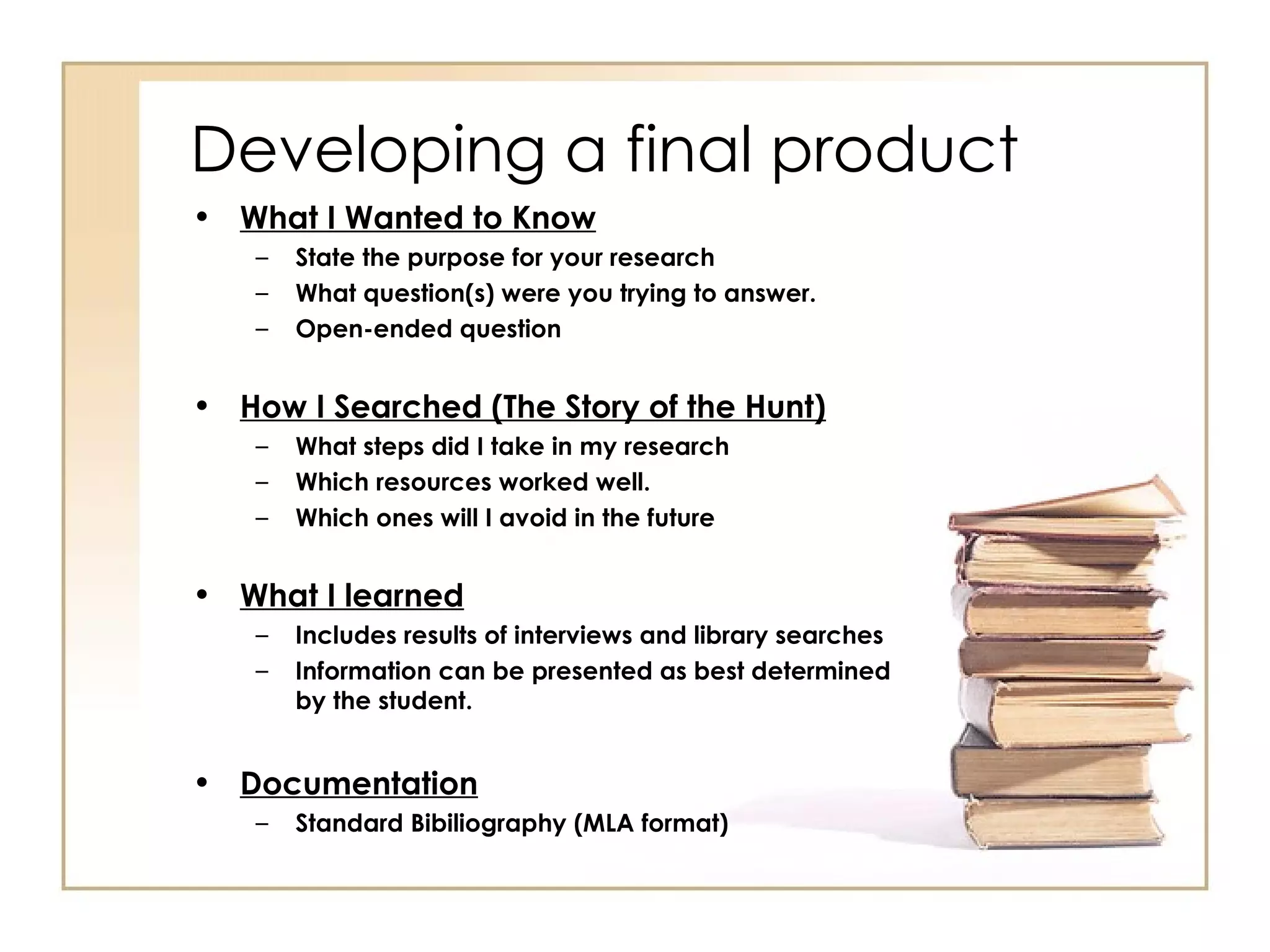
Developing a final product What I Wanted to Know State the purpose for your research What question(s) were you trying to answer. Open-ended question How I Searched (The Story of the Hunt) What steps did I take in my research Which resources worked well. Which ones will I avoid in the future What I learned Includes results of interviews and library searches Information can be presented as best determined by the student.  Documentation Standard Bibiliography (MLA format)

I Search Powerpoint

  • 1.
  • 2.
    What is anI-Search? Inquiry based approach An individualized approach to research Works with any grade level Students take an active role in process. Encourages student writing and reflection. Stresses metacognitive thinking Choose their own topics. Common themes: Careers Hobbies / interests Students may already be familiar with topics.
  • 3.
    Components Summary ofwhat students already knows. Statement of why student chose the topic. Questions about the topic student wishes to address. Record of research activities (story of the hunt) Reflections about what was discovered or learned.
  • 4.
    Four Tasks ofan I-Search Selecting a topic – exploring interests Finding information – generating questions Using information – analyzing notes Developing a final product – sharing and reflecting on experience.
  • 5.
    Selecting a topicPart I – What I already know. Here is where you write one or two paragraphs, discussing what knowledge, experience, or background you already have about your topic, BEFORE having done any research on it. Part II – What I want to find out. Here is where you put down one or two paragraphs worth of questions about your topic, questions you want badly, even desperately, to have answered. These questions will lead you to those sources that will answer your questions.
  • 6.
    Finding Information ActionPlan Here is where you develop a plan of attack for your research. What resources, materials will you need to find? What steps do you need to take to complete your research? What are the possible problems you might encounter? Research / Response Log Here is where you make notations and keep track of what research you have done and what the outcome are. You should also make notes on what steps you have taken and whether that step has been effective in completing your action plan.
  • 7.
    Using Information Hereyou will focus on three or four major findings or conclusions and support them with examples, stories, or arguments that will help the reader understand how you arrived at those conclusions. You will try to connect your findings with your original questions. They might also suggest further questions to explore in the future. You should include any analyses you did ....cause and effect, pro/con, compare and contrast, or sequencing. 
  • 8.
    Developing a finalproduct What This Means To Me Describe how you have developed as a researcher. "What do you now know about searching for information that you didn't know before?" Describe those findings that meant the most to you. Discuss how your newly found knowledge will affect the way you act or think in the future. Discuss the skills you have developed as a researcher and writer.  What I Already Knew… Discuss information you knew before you began your I-Search. How has this information changed? What do you know now that you didn’t know before?
  • 9.
    Developing a finalproduct What I Wanted to Know State the purpose for your research What question(s) were you trying to answer. Open-ended question How I Searched (The Story of the Hunt) What steps did I take in my research Which resources worked well. Which ones will I avoid in the future What I learned Includes results of interviews and library searches Information can be presented as best determined by the student. Documentation Standard Bibiliography (MLA format)